




Personal Finance Essentials
The Power of Compounding
The Math That Turns $10,000 Into $320,000
Without Adding a Dollar
Of all the forces that shape your financial future, none is more powerful – or more misunderstood – than compound interest. It is not a trick or a strategy. It is a mathematical reality that works silently and relentlessly, every day, in every account. Understood and harnessed, it is the engine of lasting wealth. Ignored or underestimated, it becomes the engine of lasting debt. Financial planning is, in large part, the art of putting compounding to work for you instead of against you.
What Is Compound Interest?
Simple interest grows in a straight line. If you deposit $1,000 at 10% simple interest, you earn $100 every year – $100, $100, $100 – for as long as you hold the account. Compound interest is different. It earns interest on your interest. In year one you earn $100. In year two you earn interest on $1,100. In year three, on $1,210. The growth is not a straight line – it is a curve that bends upward more steeply with every passing year.
This distinction may sound modest at first. Over time, it is the difference between financial mediocrity and financial independence. Albert Einstein reportedly called compound interest the eighth wonder of the world: those who understand it earn it, and those who don’t pay it. Whether or not he said it, the math proves the point.
The Rule of 72
The simplest way to understand compounding is through the Rule of 72. Divide 72 by the interest rate you are earning and the result tells you how many years it takes your money to double. At 6%, your money doubles every 12 years. At 9%, every 8 years. At 12%, every 6 years.
Run that forward over a lifetime and the numbers become extraordinary. A 25-year-old who invests $10,000 at a 9% average return will see it grow to $20,000 by 33, $40,000 by 41, $80,000 by 49, $160,000 by 57 and $320,000 by 65 – more than thirty times the original investment, without adding another dollar. Every additional year the money compounds is not merely additive. It is multiplicative. That is the nature of exponential growth.
The Lily Pad Moment
Imagine a lily pad that doubles in size every day. On day one it is barely visible on the surface of a pond. By day 15 it covers only half the pond. On day 16 it covers the entire pond. Compound interest behaves exactly the same way. The growth feels imperceptibly slow at the beginning and then suddenly overwhelming at the end.
This is why so many investors give up too early. They contribute for a few years, see only modest growth and conclude that the strategy is not working. In reality, they are on day 14 or 15 – just one doubling away from the moment when everything accelerates. Patience and consistency are not merely virtues in investing. They are the mechanism by which compounding delivers its full power.
The Earlier You Start, the Better
Consider two investors. The first starts saving $2,000 per year at age 25 and does so for just 10 years, then stops completely. The second waits until age 35 and saves $2,000 per year for 30 years without stopping.

Assuming the same rate of return, who has more money at age 65? The person who started at 25 – despite having saved for only 10 years compared to 30. The reason is pure compounding: those first 10 years of contributions had 40 years to grow.
Benjamin Franklin demonstrated this principle in his own will. When he died in 1790, he left £1,000 each to the cities of Boston and Philadelphia, with instructions that the money could not be touched for 200 years. By 1990 each city’s bequest had grown to more than $20 million. Franklin understood something most people still struggle to grasp: time is the single most important ingredient in wealth creation. No investment strategy, no matter how clever, can fully compensate for time that has already passed.
The Cost of Waiting
Every year of delay in saving carries a permanent price tag. A 25-year-old who saves $3,000 per year for 40 years at 10% accumulates approximately $1.4 million by age 65. A person who waits until age 35 and saves the same $3,000 per year for 30 years accumulates only $540,000 – less than half as much, despite saving for only 10 fewer years and putting in $30,000 less in total contributions.
The missing decade at the beginning is the most expensive decade of all. Those early contributions have the most years to compound and therefore carry the most weight in the final outcome. Waiting until you feel financially ready, until a debt is paid off or until the timing seems better will cost far more than the amount you eventually invest. The best time to start was yesterday. The second-best time is today.
When Compounding Works Against You
Compounding is indifferent to who benefits from it. When you invest, it works for you. When you borrow at high interest rates, it works against you with equal force. A credit card charging 18% interest doubles the debt owed in approximately four years if no payments are made. A family carrying a credit card balance at 18% while simultaneously saving at 5% is effectively losing 13% on every dollar trapped in that debt – compounding in the wrong direction.
This is why eliminating high-interest consumer debt is almost always the first priority in any sound financial plan. It is not just about reducing a balance – it is about stopping compounding from running in reverse. Once debt is cleared, the same mathematical force that was draining your wealth begins building it. The transition from paying compound interest to earning it is one of the most consequential financial turning points in a person’s life.
Tax Deferral and the Compounding Multiplier
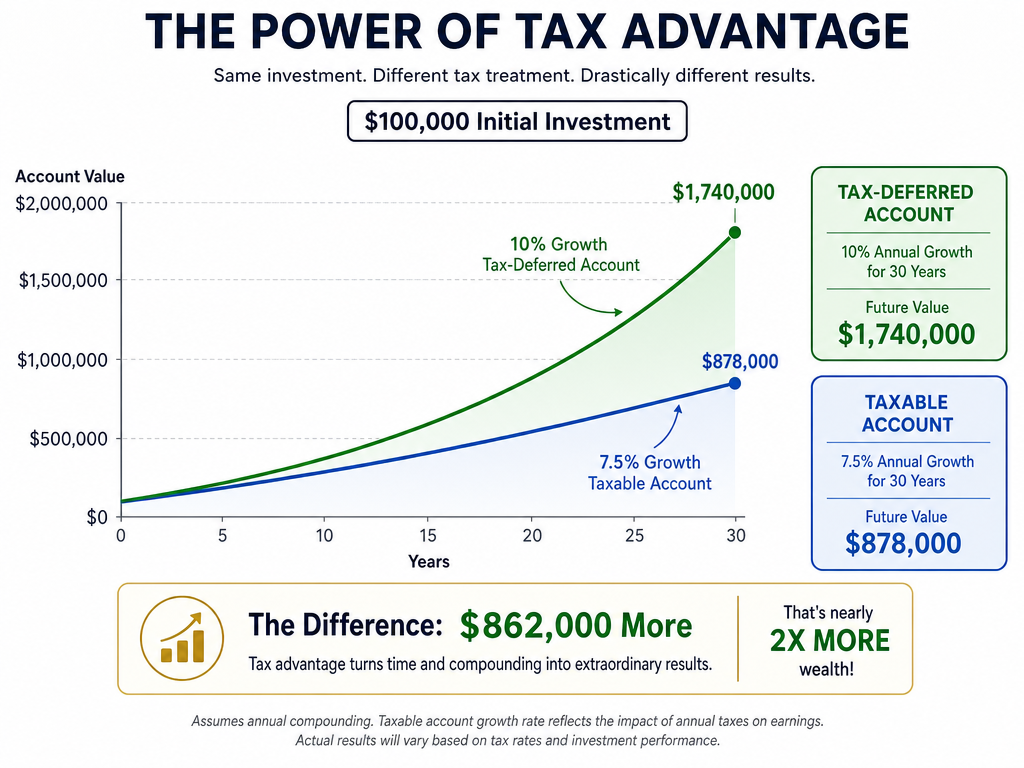
Compound interest is powerful on its own. Combined with tax deferral, it becomes dramatically more so. In a standard taxable investment account, you pay taxes on dividends, interest and realized gains each year. If you are in the 25% tax bracket and earning 10%, your effective after-tax return is closer to 7.5%. In a tax-deferred account – a 401(k) or IRA – all growth compounds at the full 10% rate until you withdraw the money.
The difference is not trivial. A $100,000 investment growing at 10% for 30 years in a tax-deferred account becomes approximately $1.74 million. The same investment growing at 7.5% in a taxable account becomes roughly $878,000 – barely half as much. The missing $860,000+ did not go to poor investment selection or market timing. It went to taxes paid each year on gains that could have been compounding instead. This is why contributing to tax-advantaged retirement accounts before investing in taxable accounts is almost always the right choice.
Compounding in Practice
Understanding compounding changes the way you see every financial decision. A dollar spent today is not just a dollar – it is every dollar that dollar would have become over the next 20 or 30 years. A dollar saved and invested today is not just a dollar either. It is a seed. That reframing is not meant to produce anxiety about spending. It is meant to clarify the real stakes of financial choices and reinforce why a thoughtful plan matters.
The most successful investors are not the most brilliant or the most well-informed. They are the most consistent. They save regularly, invest in diversified portfolios, avoid the temptation to react to short-term market movements and let time do the heavy lifting. Compounding rewards patience and punishes impatience. A financial plan is simply the structure that makes patience possible – the commitment to let the math run its course.
