


Personal Finance Essentials
Maintain a Long-Term Perspective
- Back to Investment Management
- Start Now – and Never Stop
- Put Compounding to Work for You
- Maintain a Long-Term Perspective
- The Cost of Procrastination
- The Two Ways to Manage Your Investments
- The Power of Diversification
- Modern Portfolio Theory: A Scientific Approach to Investing
- The Importance of Rebalancing
- The Best Investment Approach of All: Dollar Cost Averaging
- Keeping More of Your Profits via Tax Loss Harvesting
- The Goal of Investing: Financial Security
- The Hidden Threat: Inflation and Taxes
- Understanding Risk and Volatility
- The Psychology of Investing: Overcoming Emotional Errors That Prove Costly
Successful Investors Understand That
True Wealth Accumulation Happens Over Decades, Not Days or Months.
Investing is not a sprint; it’s a marathon. Successful investors understand that true wealth accumulation happens over decades, not days or months.
The Market’s Historical Record
Consider that, since 1926, the stock market has been profitable:
In other words, it doesn’t matter so much when you invest, compared to how long you invest.
Imagine a boy walking up a steep hill while playing with a yo-yo. If you focus only on the yo-yo’s wild movements, you’ll miss the fact that the boy is steadily climbing higher. Each low point of the yo-yo is higher than the last because the boy is on higher ground.
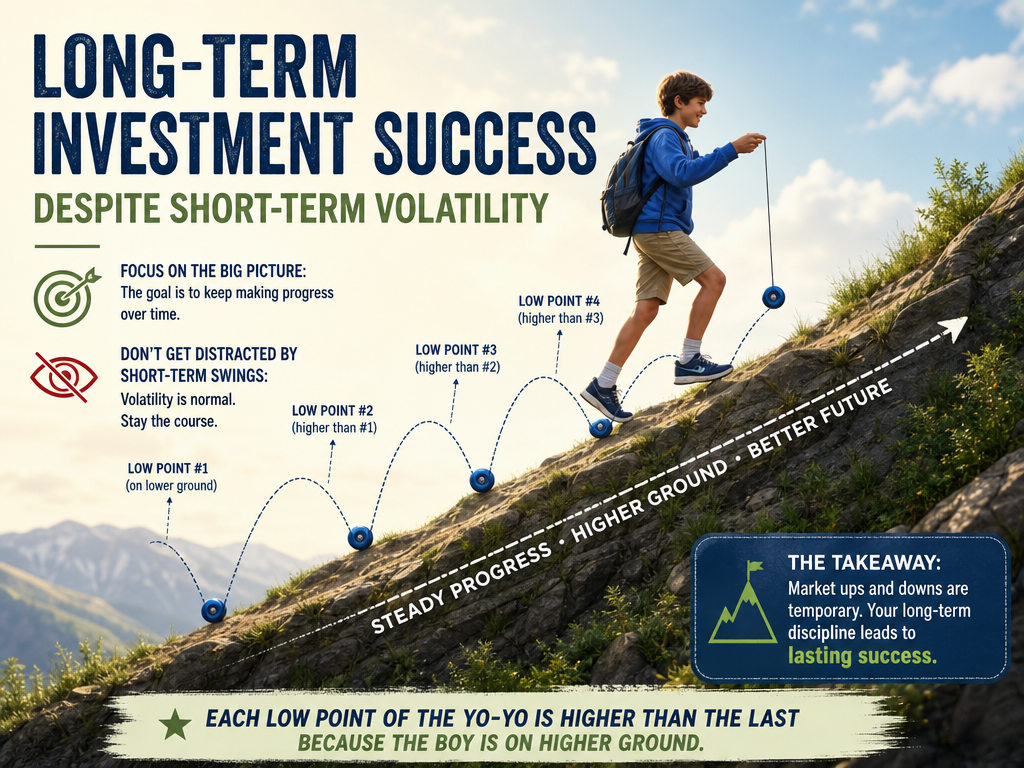
Or compare investing to the ocean: waves represent the stock market’s daily fluctuations – volatile and unpredictable – while the tides reflect the stock market’s long-term trend – both predictable and stable. Successful investors focus on the boy and the hill, not the yo-yo, and on the tide instead of the waves.

The Cost of Missing the Market’s Best Days
Studies reveal just how critical it is to stay invested. In the twenty-year period ending December 31, 2024, according to J.P. Morgan Asset Management, a fully invested S&P 500 investor earned an annualized return of approximately 10.5%. Missing just the ten best days reduced that return to 6.2%; missing the twenty best days cut it to just 3.6%. Notably, seven of the ten best market days occurred within fifteen days of the ten worst days – underscoring why exiting the market during downturns can prove so costly. Because stock market gains arrive in short, unpredictable spurts, being invested all the time is the only reliable way to capture them. “Timing” doesn’t matter – “time in” does.