


Personal Finance Essentials
Put Compounding to Work for You
- Back to Investment Management
- Start Now – and Never Stop
- Put Compounding to Work for You
- Maintain a Long-Term Perspective
- The Cost of Procrastination
- The Two Ways to Manage Your Investments
- The Power of Diversification
- Modern Portfolio Theory: A Scientific Approach to Investing
- The Importance of Rebalancing
- The Best Investment Approach of All: Dollar Cost Averaging
- Keeping More of Your Profits via Tax Loss Harvesting
- The Goal of Investing: Financial Security
- The Hidden Threat: Inflation and Taxes
- Understanding Risk and Volatility
- The Psychology of Investing: Overcoming Emotional Errors That Prove Costly
Long-Term Saving Requires
Sufficient Returns to Create Wealth

It’s not enough that you save for a long time – it’s equally important that your savings earn sufficient returns so that you can actually create wealth.
The Math Behind the Magic
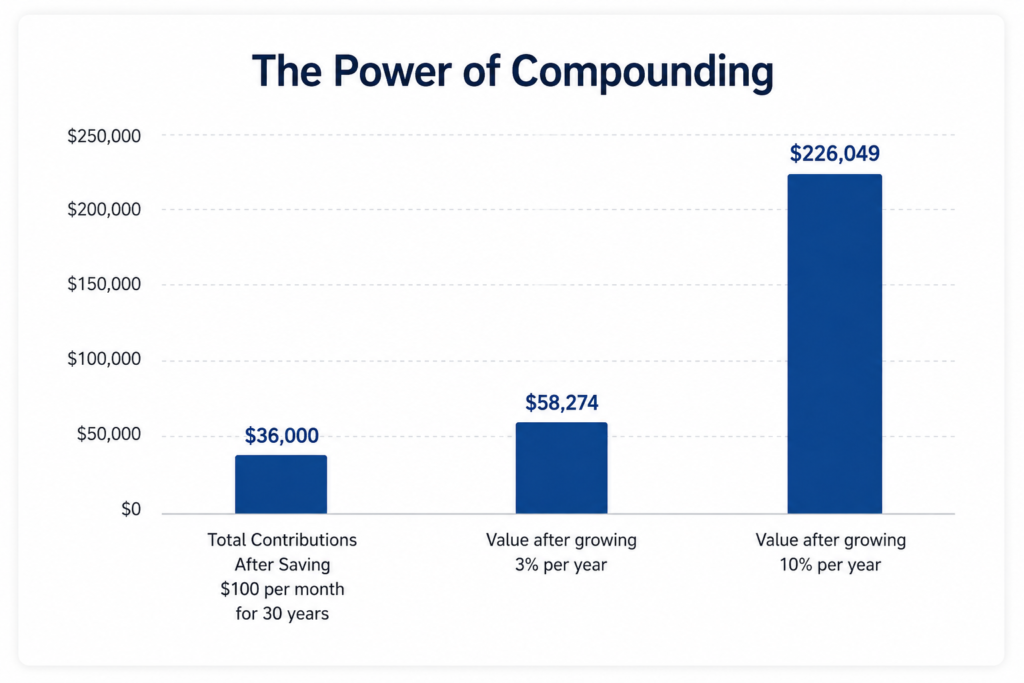
If you save $100 per month for 30 years, you’ll invest a total of $36,000. If you earn 3% per year in a money market fund or bank CD, you’ll have $58,274. But if you earn 10% per year, you’ll have $226,049. That’s the power of compounding.
The key insight is that money doesn’t grow in a straight line – it grows exponentially. It’s not enough that you save, or even that you save for a long time; it’s equally important that your savings earn sufficient returns so you can actually create wealth.
The Rule of 72
A quick way to estimate how fast your money will double is the Rule of 72: divide 72 by your rate of return, and the result is the approximate number of years it takes for your money to double. At 6%, your money doubles every 12 years. At 10%, every 7.2 years.
Reinvest Everything
One of the most common ways investors undermine compounding is by spending the interest and dividends they earn. All too often, people deposit these payments directly into their checking accounts – and away the money goes. For compounding to work, you must reinvest your earnings, not spend them. This allows interest to earn interest on top of interest, which is the entire basis for exponential growth.