


Personal Finance Essentials
The Future: Tokenization and the Future of Money
- Back to Crypto
- The Past: The History of Money
- What Motivated Satoshi to Invent Bitcoin?
- How Satoshi Invented Bitcoin
- How Bitcoin Works
- Why the Bitcoin Blockchain Requires Bitcoin
- Bitcoin Pizza Day: The First Commercial Use of Bitcoin
- How Blockchains Work
- The Problem of Double Presentment
- Two Ways to Authenticate Data on a Blockchain
- How Do We Know that Data on the Nodes are Authentic?
- Bitcoin was the First Digital Asset. Why Do We Need Any Other Coins?
- The Present: Blockchains Today
- Public and Private Keys
- Types of Crypto Wallets
- The Commercial Uses of Blockchain Technology
- The Future: Tokenization and the Future of Money
- The Risks of Digital Assets
From Pizza Slices to Building Shares:
The Tokenization Revolution
Tokens are physical representations of something intangible. For decades, you needed a token to ride on the New York subway. You use tokens to play games at amusement parks. A “token gesture” is a small act representing your feelings – as in handing a rose to your love.
Note the word “small” in that paragraph. It’s key. Consider buying a large pizza. You can’t eat it all, so you slice the pie into eight pieces. Each piece is a slice, a share of the pie.
Ditto for stocks. Wouldn’t it be cool to own Apple? I mean, the entire company! Unfortunately, Apple is worth about $4 trillion. Fortunately, you can buy a tiny slice of the company –a share, just like our pizza pie – and you’ll own some of Apple. The more shares you buy, the more of the company you own.
In the crypto world, there aren’t any shares. Instead, there are coins. And sometimes, they are called tokens. Shares, coins and tokens are synonyms.
Can you think of an asset that is worth a lot of money but notoriously difficult to sell? Real estate.
All Real-World Assets Can Be Tokenized
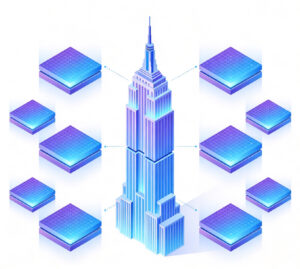
It would be cool to own, say, the Empire State Building. But the building is worth $3 billion. That’s a problem for you since you don’t have that much money. It’s also a problem for the building’s owner, who therefore struggles to find a buyer with enough money to purchase the building. This is why real estate is considered an illiquid asset.
Blockchain to the rescue.
The owner of the building could tokenize the property – issuing tokens just like Apple issues shares. Each token would represent part ownership of the building. If the owner issues 30 million tokens, each would be worth $100, making them affordable to millions of investors, who could buy them, and then easily trade the tokens among themselves, just as they do with shares of stocks.
The first tokenized real estate transaction was completed in 2018 – a $30 million condo in Manhattan. Since then, dozens of buildings have been tokenized – from the St. Regis hotel in Aspen to properties in Dubai and Japan.
Real estate is the most valuable asset class in the world – 3 times bigger than the global stock market – and all of it can be tokenized, creating a massive new asset class for investors. And by doing so, one of the world’s largest but illiquid assets can become as liquid and easily tradeable as stocks.
Imagine being able to tokenize your home. Why would you want to? Well, if you’re like most homeowners, your house is your largest asset. Say it’s worth $1 million. You’re in retirement and you need additional income to support yourself. You could sell your home, but you don’t want to move. So, tokenize the house. Slice the deed into 100,000 tokens, each worth $10. Then, sell as many as you want, whenever you want.
Any physical asset can be tokenized, including artwork, collectibles (such as baseball cards, rare coins, and stamps), antiques, exotic cars, fine wine, royalty, and performance contracts (the money that actors, artists, athletes and authors earn over time). Sellers get liquidity and buyers get access to new investment opportunities – and unprecedented ways to create astonishing new levels of portfolio diversification, more than ever before.
Solving Problems with Tokenization
Some assets are desirable because they:
Offer potential to increase in value
Generate income or cash flow
Feature opportunities to reduce how much you owe in taxes
Unfortunately, some assets that have these attributes are unavailable to many investors because of lack of access, liquidity, or affordability. Let’s explore these problems and see how tokenization solves them.
Inaccessibility
THE PROBLEM
Some investments are available only to people and entities with certain “connections” to owners and sellers. For example, you might be interested in investing in a certain work of art, but the owner is likely to sell it to collectors they already know—denying you the opportunity to acquire it.
THE SOLUTION
When you tokenize, you convert a single asset into many new assets, each a fraction of the original. Instead of one pizza pie, for example, you create eight pizza slices that comprise the entire pie.
Say you have a commercial office building worth $2 billion. Few have the ability to purchase such an asset, but if you carve ownership into 200 million tokens that are worth $10 each, virtually anyone can buy a piece of the building. By creating all those tokens, you’ve demonetized it (reducing the cost of ownership from $2 billion to just $10) and you’ve democratized it (by making it available to everyone). For the first time, ordinary investors have the ability to own assets that were previously available only to the wealthiest of investors.
Illiquidity
THE PROBLEM
Some investments are difficult to sell—a fact that homeowners often discover. Being unable to easily sell an asset can force an owner to accept a price far below its value.
THE SOLUTION
It’s not easy to sell a $2 billion building because so few people or entities have the means to buy it. But by creating 200 million tokens, you’ve established a large and open marketplace for investors, and the tokens can trade 24/7/365. This means you always have immediate access to your money (albeit at current market prices, which might fluctuate).
As a result, you don’t have to sell the entire building for $2 billion all at once. You can instead sell just some of the tokens, and you can sell some on an ongoing basis. The open marketplace creates liquidity as some investors wish to buy, while others choose to sell.
Unaffordability
THE PROBLEM
Some investments are priced so high that many investors can’t afford to buy them.
THE SOLUTION
Few have the money to buy a $2 billion building, but almost everyone can afford to buy a $10 share of that building.
Tokenization brings all assets within the reach of virtually all investors, allowing almost everyone to engage in the financial markets, giving them the opportunity to create wealth the same way today’s richest investors create and manage their own wealth.
Other Types of Tokens
Not all tokens are meant to create investment opportunities. Let’s look at additional ways tokens can be used.
Utility Tokens
Governance Tokens
Non-Fungible Tokens
But a non-fungible token is unique. Like paintings by Picasso, no two are alike. If your sister lends you her 2023 dark blue Prius, you need to return that very car to her – not some other vehicle. Your sister’s Prius is non-fungible.
Soon, all real-world assets (RWA) will be tokenized. Instead of carrying a physical copy of your passport and driver’s license, you’ll hold them as NFTs in your digital wallet. Your education records, medical records and employment records will all be NFTs – digitally secure and easily shared with whomever you like, anytime you like.
Concert tickets, airplane tickets, car rentals. In the digital world, everything can be tokenized, monetized, and democratized. The only requirement for participation is possession of a smartphone connected to the internet.
Learn More: The Risks of Tokenization
The potential for tokenization is exciting, but there are significant risks for investors. These include:
Categories of Investors
Aspiring Affluent
Households that have credit card debts, personal loans, and little-to-no savings, but who are interested in and working toward improving their personal finances. Financial advisors generally agree that this group should not purchase investments until they have paid off their credit card debts and personal loans, and established ample cash reserves.
Emerging Affluent
Households that have eliminated their credit card debts and personal loans, but generally have less than $100,000 in savings and investments (excluding their home).
Mass Affluent
Households that have $100,000 to $3 million in savings and investments (excluding their home).
High Net Worth
Households that have $3 million to $20 million in investments (excluding their home).
Ultra-High Net Worth
Households that have $20 million to $200 million in investments.
Family Office
Households that have $200 million to many billions of dollars in investments.
Institutional Investor
Endowments, pension funds, insurance companies, sovereign wealth funds, and other entities that invest their own money or money they are managing on behalf of others. Institutional investors might control assets ranging from a few million dollars to trillions of dollars.