


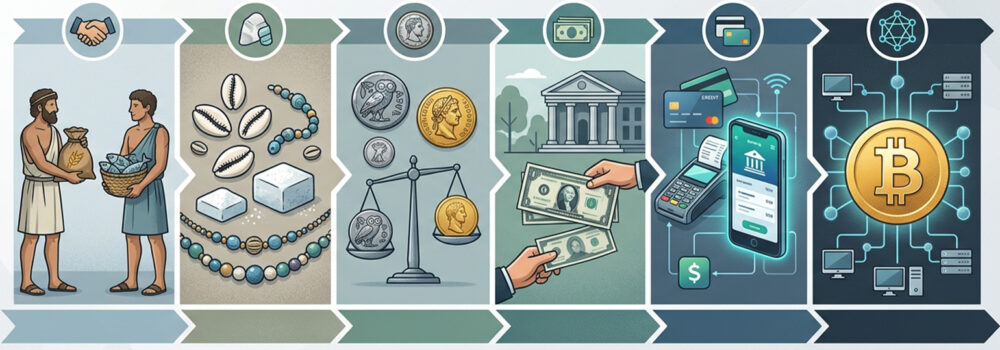
Say you have something I want, and I have something you want. Let’s trade! This is called the barter system, and it was used by Mesopotamians, Phoenicians and Babylonians as far back as 6000 BCE.
But bartering is cumbersome and inefficient. If you have milk but want sugar, you must carry that milk with you until you find someone who has sugar. An easier method of exchange was needed – and that’s what led to the invention of money.
Instead of carrying milk, you can carry money. When you find someone who has sugar, you can give them money instead of milk. Later, they can give the money to someone who has something they want. Money thus makes it very efficient to conduct commercial transactions.
But what is money? Our ancestors used all sorts of items to serve as money, including animals, crops, shells, metal, paper, salt, even large rocks. (People living in the Yap Islands of Micronesia used stones as money, called rai. The diameter of these stones ranged from about 1.5 inches to 12 feet, and they weigh up to 8,800 pounds! (Being too difficult to move, ownership was maintained via oral history. Today, you can find these stones on the islands as well as in museums worldwide.)
People know where milk comes from, and how much is needed to exchange for a cup of sugar. But where does money come from, and how much of it is needed to trade for sugar?
That’s a vexing question, because in the early days of money, anybody could create it – and many individuals and businesses did. As you might expect, valuations were often disputed. To establish agreement over money’s value, and to create confidence in that value, governments soon declared that they were to be the only creators of money.
That would seem to have solved the problem. But governments come and go, and there’s always more than one. During the early days of America, for example, all 13 colonies issued money – and there was disagreement about their relative values.
You know how it all turned out: The federal government is now the sole issuer of money in the United States. It’s the same for every country; only the national government creates and issues money.
Money created by a government is called currency, and it goes by many names: dollars, euros, rubles, yen, pounds, and more. In the U.S., the Treasury Department’s Bureau of Printing and Engraving prints 4.2 billion pieces of currency every year.
 It’s easier to carry money than milk, but money is still a hassle – especially if you have a lot of it. So, at the same time the federal government created money, it created a bank to give people a place to store their money. That bank – the Bank of New York – was founded in 1784 by Alexander Hamilton, and it still exists today, as part of BNY Mellon.
There are lots of banks today, of course, but each country has one “central bank.” That’s the one operated by the federal government, and it determines how much money is made available, among other things. In the U.S., our central bank is called the Federal Reserve Bank, or Fed for short.
For thousands of years, all money was exchanged manually. When computers came into commercial use, banks began allowing people to exchange money digitally. Today, you do most of your financial transactions that way: your paycheck is direct-deposited to your bank account, and your monthly bills are set to auto-debit from there, too. You make purchases by using credit cards, debit cards, PayPal, Venmo and Zelle, and you redeem loyalty rewards online. You rarely use physical money, called cash. And yet, the Treasury Department keeps printing it.
We’ve digitized almost everything else – from photos to health records to concert tickets – so it was inevitable that somebody would suggest that we digitize our money. That somebody wasn’t the Federal Reserve, the United Nations, the World Bank, or the International Monetary Fund. It was Satoshi Nakamoto. No one knows who that is, but Satoshi invented a new form of money. Digital money. And Satoshi called it bitcoin.
